0%
Reading Progress
Scroll to track your progress
Frequently Asked Questions
Frequently Asked Questions
1. What is a growth scan during pregnancy?
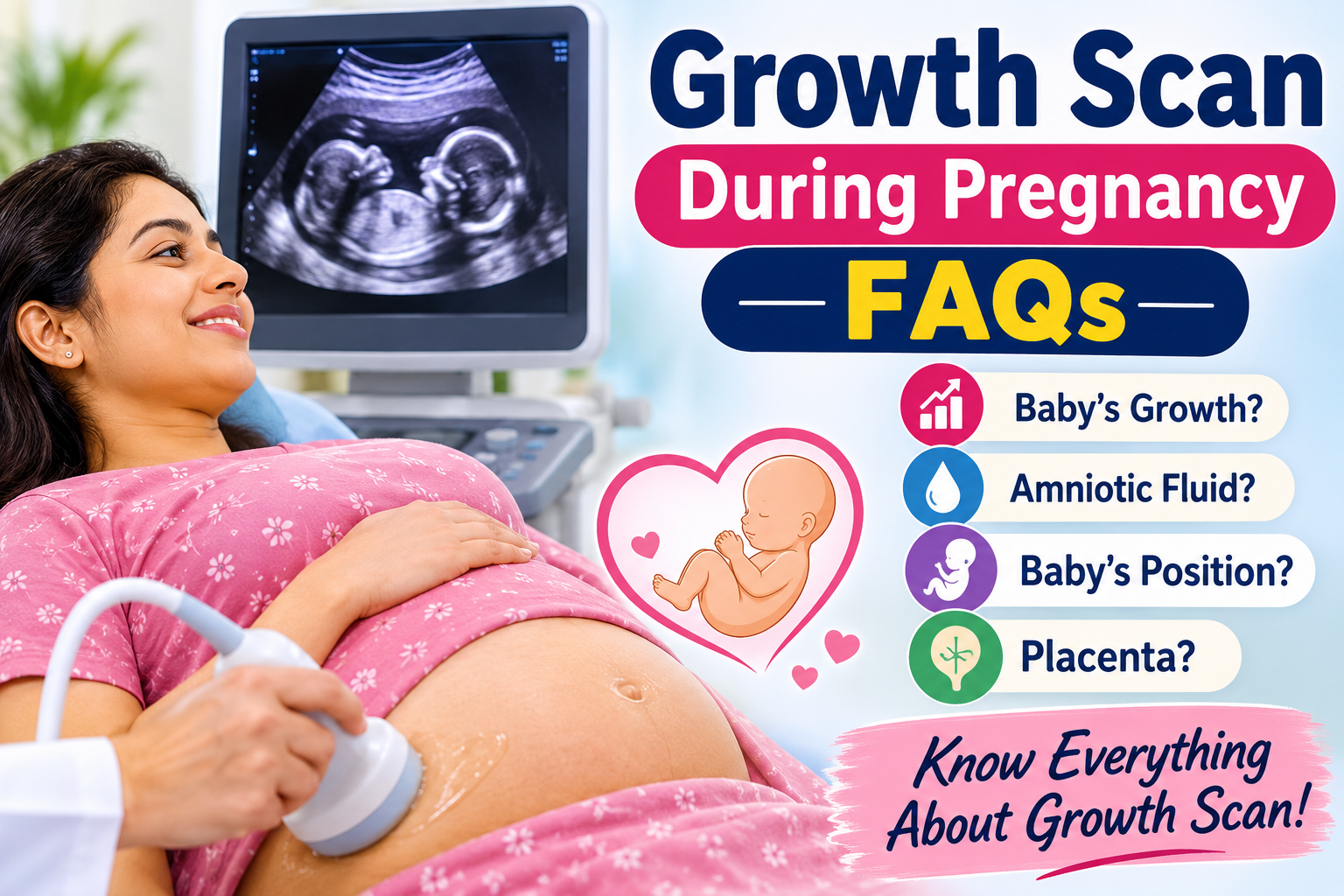
A growth scan is an ultrasound examination that measures the baby's size, weight, and development inside the womb. It helps assess whether the baby is growing normally according to the pregnancy weeks.
2. When is a growth scan performed?
A growth scan is commonly performed between 28 and 36 weeks of pregnancy. The timing may vary depending on the mother's health and the doctor's recommendation.
3. Why is a growth scan important?
A growth scan helps to:
Monitor the baby's growth and development.
Estimate the baby's weight.
Check the baby's position.
Assess the amniotic fluid level.
Examine the placenta.
Identify signs of restricted or excessive fetal growth.
4. Is a growth scan necessary for every pregnant woman?
Not every pregnant woman requires repeated growth scans. Doctors may recommend them based on routine antenatal assessment, medical conditions, pregnancy complications, or concerns about the baby's growth.
5. What measurements are checked during a growth scan?
The scan usually measures:
BPD (Biparietal Diameter): Measures the width of the baby's head.
HC (Head Circumference): Measures the circumference of the baby's head.
AC (Abdominal Circumference): Measures the baby's abdominal size.
FL (Femur Length): Measures the length of the baby's thigh bone.
EFW (Estimated Fetal Weight): Estimates the baby's weight.
6. Can a growth scan detect whether the baby is growing properly?
Yes. It helps doctors assess the baby's growth by comparing measurements with expected values for the gestational age. It can identify babies who may be smaller or larger than expected.
7. What is the normal fetal weight during a growth scan?
The baby's expected weight varies according to the number of pregnancy weeks. Doctors compare the estimated fetal weight with standard growth charts to determine whether growth is appropriate.
8. Can a growth scan detect low amniotic fluid?
Yes. A growth scan can assess the amount of amniotic fluid surrounding the baby. Low or excessive fluid levels may require further monitoring and medical evaluation.
9. Does a growth scan check the baby's position?
Yes. It helps identify whether the baby is in a head-down, breech, or transverse position.
10. Can a growth scan identify placental problems?
Yes. The scan can assess the placenta's location and appearance. Doppler ultrasound may also be recommended to evaluate blood flow between the placenta and baby.
11. Is a growth scan painful?
No. A growth scan is a painless and non-invasive procedure. A sonographer applies ultrasound gel to the mother's abdomen and moves a probe over the skin to obtain images.
12. How long does a growth scan take?
A growth scan usually takes around 15–30 minutes. The duration may vary depending on the baby's position and the measurements required.
13. Is a growth scan safe for the baby?
Yes. Ultrasound scans use sound waves rather than radiation and are considered safe when performed by trained healthcare professionals for appropriate medical reasons.
14. Is fasting required before a growth scan?
No. Fasting is generally not required before a growth scan. Pregnant women can usually eat and drink normally unless their healthcare provider gives different instructions.
15. What is the difference between an anomaly scan and a growth scan?
An anomaly scan and a growth scan have different purposes.
Anomaly scan: Mainly checks the baby's anatomical structures and identifies certain structural abnormalities, usually around 18–22 weeks.
Growth scan: Mainly assesses the baby's size, estimated weight, amniotic fluid, position, and placental condition, usually during later pregnancy.
16. What happens if the baby is measuring smaller than expected?
If the baby is smaller than expected, the doctor may recommend repeat growth scans, Doppler studies, and additional monitoring to check the baby's well-being and identify possible fetal growth restriction.
17. What happens if the baby is measuring larger than expected?
A larger-than-expected measurement may be associated with factors such as gestational diabetes or normal variations in fetal growth. The doctor may recommend further assessment if necessary.
18. Can a growth scan predict the baby's exact birth weight?
No. A growth scan provides an estimated fetal weight, not the exact birth weight. There can be a margin of error in ultrasound weight estimation.
19. How many growth scans are required during pregnancy?
The number of growth scans depends on the pregnancy and the mother's health. Some women may need only one scan, while others may require multiple scans for monitoring.
20. Does a growth scan help determine the mode of delivery?
A growth scan provides useful information about the baby's estimated weight, position, and well-being. However, the decision about vaginal delivery or caesarean section depends on several maternal and fetal factors.
Conclusion
A growth scan is an important ultrasound examination that helps monitor fetal growth and assess the baby's well-being during pregnancy. It provides valuable information about the baby's estimated weight, amniotic fluid, placental condition, and position. Regular antenatal check-ups and scans recommended by the doctor help support a healthy pregnancy.
AI GENERATED
Verified and approved by
Ms. Siddiq nisha U. Bsc (Nsg)
Dr. Karthikeyan S. MBBS.,