0%
Reading Progress
Scroll to track your progress
Frequently Asked Questions
1. What is a hernia?
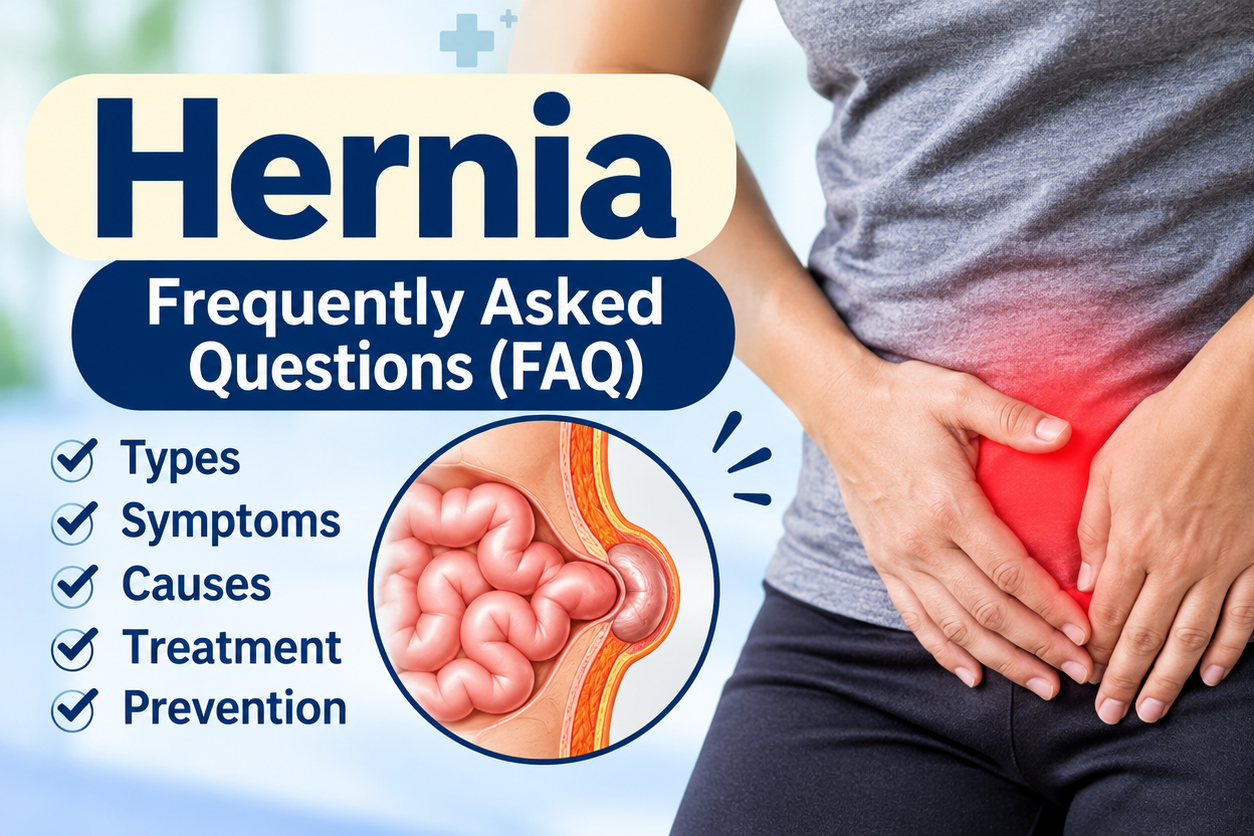
A hernia occurs when an internal organ or fatty tissue pushes through a weak spot in the surrounding muscle or tissue. It commonly affects the abdomen, groin, or belly button area.
2. What are the common types of hernia?
The most common types include:
Inguinal hernia: Occurs in the groin area.
Femoral hernia: Develops in the upper thigh, near the groin.
Umbilical hernia: Occurs around the belly button.
Hiatal hernia: Happens when part of the stomach pushes through the diaphragm into the chest.
Incisional hernia: Develops through a weakened area of a previous surgical incision.
Epigastric hernia: Occurs in the upper abdomen, between the chest and belly button.
3. What are the common symptoms of a hernia?
Common symptoms include:
A visible bulge or swelling in the abdomen or groin.
Pain or discomfort in the affected area.
A feeling of heaviness or pressure.
Pain while coughing, bending, or lifting objects.
Burning or aching sensations around the bulge.
Some hernias may not cause noticeable symptoms.
4. What causes a hernia?
A hernia develops due to muscle weakness or increased pressure inside the abdomen.
Common causes include:
Heavy lifting.
Chronic coughing.
Constipation and frequent straining.
Obesity.
Pregnancy.
Previous abdominal surgery.
Weak abdominal muscles.
Age-related muscle weakness.
5. Who is at risk of developing a hernia?
Anyone can develop a hernia. However, the risk is higher in people who:
Are overweight or obese.
Frequently lift heavy objects.
Have a family history of hernia.
Have chronic cough or constipation.
Have undergone abdominal surgery.
Are born with weak abdominal muscles.
6. Can a hernia cause pain?
Yes. A hernia can cause mild to severe pain or discomfort. The pain may become worse when coughing, bending, exercising, or lifting heavy objects. Some hernias are painless.
7. How is a hernia diagnosed?
A doctor usually diagnoses a hernia through:
Physical examination.
Ultrasound scan.
CT scan, when necessary.
MRI in selected cases.
The doctor may ask the patient to cough or strain during the examination to identify the hernia.
8. Can a hernia heal on its own?
Most hernias do not heal on their own because the muscle weakness or opening remains. Some small hernias may be monitored by a doctor if they are not causing symptoms. However, medical evaluation is important to determine the appropriate treatment.
9. What are the treatment options for hernia?
Treatment depends on the type, size, symptoms, and risk of complications.
Common treatment options include:
Watchful waiting: Monitoring selected hernias that are not causing significant symptoms.
Open hernia surgery: The surgeon repairs the weakened area, sometimes using surgical mesh.
Laparoscopic surgery: A minimally invasive procedure performed through small incisions.
Robotic-assisted surgery: Used in selected cases.
10. Is hernia surgery necessary?
Not every hernia requires immediate surgery. However, surgery is often recommended for symptomatic hernias or those that are increasing in size. Some types, particularly femoral hernias, may require earlier surgical treatment because of their higher risk of complications.
11. What happens if a hernia is left untreated?
An untreated hernia may increase in size and cause discomfort. In some cases, serious complications can develop, such as:
Incarcerated hernia: The protruding tissue becomes trapped and cannot move back into place.
Strangulated hernia: The blood supply to the trapped tissue is cut off, which is a medical emergency.
12. What are the warning signs of a strangulated hernia?
Seek immediate medical attention if you experience:
Sudden or severe abdominal pain.
Vomiting or nausea.
Fever.
A bulge that becomes hard, tender, or cannot be pushed back.
Redness or darkening of the skin over the bulge.
Inability to pass stools or gas.
These symptoms may indicate a serious complication requiring emergency surgery.
13. Can exercise cause a hernia?
Heavy lifting, improper lifting techniques, and activities that increase abdominal pressure may contribute to hernia development, particularly in people with weakened abdominal muscles. However, regular moderate exercise does not automatically cause a hernia.
14. Can a hernia be prevented?
Not all hernias can be prevented, but certain lifestyle habits may reduce the risk:
Maintain a healthy body weight.
Avoid lifting heavy objects incorrectly.
Eat fibre-rich foods to prevent constipation.
Treat chronic cough.
Avoid excessive straining during bowel movements.
Strengthen muscles through appropriate exercise.
15. How long does it take to recover from hernia surgery?
Recovery depends on the type of surgery and the patient's overall health.
Many patients return to light daily activities within a few days.
Recovery after laparoscopic surgery may be quicker in some patients.
Full recovery often takes around 4–6 weeks, sometimes longer.
Patients should follow their surgeon's instructions regarding exercise, lifting, and daily activities.
16. Can a hernia come back after surgery?
Yes. Although hernia surgery is generally successful, there is a possibility of recurrence. The risk depends on the type of hernia, surgical technique, wound healing, and individual health factors.
17. Is a hernia a serious medical condition?
Many hernias are not immediately dangerous. However, complications such as incarceration and strangulation can become life-threatening. Early medical evaluation and appropriate treatment are important.
Conclusion
A hernia is a common medical condition that occurs when an organ or tissue pushes through a weakened area of muscle or connective tissue. Recognising the symptoms and seeking timely medical advice can help prevent complications. Treatment may involve regular monitoring or surgical repair, depending on the type and severity of the hernia.
AI GENERATED
Verified and approved by
Ms. Siddiq nisha U. Bsc (Nsg)
Dr. Karthikeyan. MBBS.,